Friday, December 31, 2010

Homemade Chinese Barbeque Pork (Char Siu)


One of my specialites developed over the last few years is chinese barbeque pork or char siu. I guess practice makes perfect and this dish remains a favourite with my family and friends. The only problem with this recipe is that I don't measure my ingredients. I just add a dash of this and a dash of that. Also, I tend to improvise my ingredients depending on what I have available in my pantry so my advice if you're trying this recipe is to be adventurous :-)

Here is my recipe, to the best of my estimation...

Serves 4-8 (depending on whether you're serving other dishes)
1. 8 strips of pork belly (you do need a fatty cut in order for this dish to be successful. A fatless cut would result in a rather dry and chewy char siu)
2. 1 jar (240 gm) of Lee Kum Kee Char Siu sauce
3. 1/2 jar (120 gm) of Lee Kum Kee Hoisin sauce

4. 1/4 cup of honey
5. 1 tablespoon of five spice powder
6. 2 tablespoons of lemon/lime juice
7. 2 tablespoon of Lea & Perrins Worchestershire Sauce
8. 1-2 teaspoons of thick soya sauce
9. 1 tablespoon of Chinese wine
10. 1 teaspoon salt and pepper
11. 1-2 tablespoon of Maltose sugar (Mak Ngah Tong)

Marinade:Mix ingredients 2-10 in a deep glass dish. Place each strip of pork belly into the marinade and make sure that each pork belly is coated with the marinade. Using a fork, pierce the meat to allow it to absorb the marinade into the meat. Ideally, the marinade should totally cover the meat. Marinade overnight in the fridge.

Pre-Roast:45 minutes before roasting, take out the pork belly from the fridge. Preheat oven to 180C. Wrap your roasting rack and tray with aluminium foil (it will make cleaning up much easier). Slit some holes on the rack to allow the liquid to drip down to the tray. Place the pork belly on the rack and pour half of the marinade over the meat.

Now for the key ingredient - maltose sugar. Pour some boiling water onto a large bowl. Place the maltose sugar jar into the bowl. This will warm up the thick maltose sugar into a more liquid syrup, making it easier to pour on the pork belly. Using a large spoon, scoop up the maltose sugar. Lift your hands high and start lacing the pork belly until the maltose sugar coats the pork belly fairly evenly.

Roast:
Roast in the oven for around 30-45 minutes. Midway through, turn the meat and baste with the remaining marinade. If you wish, you can also add the maltose sugar again (I used to but don't anymore). When the char siu is cooked, remove the meat from the rack and the gravy from the tray. Once the meat is cool, slice and serve with rice or noodles. Enjoy!

Sunday, December 26, 2010

Love that keeps on giving

It's Boxing Day today. Time to put away the gift boxes. For many Christmas is about Santa and Christmas presents. For some, the toys will be played with for a a seaon before being tossed aside. Rarely will gifts last forever. But Pastor reminded us during Christmas service, at its heart, Christmas means no matter what else will disappear in the future God's love will last forever.

1 John 4:9-10
By this the love of God is revealed in us: that God has sent his one and only Son into the world so that we may live through him.
In this is love: not that we have loved God, but that he loved us and sent his Son to be the atoning sacrifice for our sins.

Saturday, December 18, 2010

The Best of Takayama, Japan

As we made our way south from Tokyo/Hakone to Kyoto, we took a detour cum side trip to the lovely town of Takayama, in the mountainous Hida district (west of Honshu Island). The journey on the Shinkansen involves a change of trains at Nagoya. The train journey from Hakone inclusive of transfers takes about 4.5 hours, but the scenery in the Hida region is spectacular. We also discovered later that the food rivals the scenery!

One of the many beautiful gorges in the Hida district


In spring, the cherry blossoms bloom by the riverside

Upon arrival in Takayama, we made our way on foot to our hotel, The Rickshaw Inn. As mentioned in an earlier post, it makes sense in Japan to use the luggage forwarding service. The Rickshaw Inn is centrally located in town. This small narrow inn is very popular among travellers as it is clean,reasonably priced and offers a little kitchen and laundry facility.


Our Japanese room - mattress on tatami mat.

Taller individuals (6 footers and above) should be careful when exiting the bedrooms as the door is quite short. They post a notice to be careful on the outside door but not on the inside. The bedroom is spacious but the bathrooms are rather narrow, typical of Japanese hotels.

We headed out to dinner to Origin, a Japanese pub (izakaya) located close to the train station. You won't find an English signage in the front, so look out for the bamboo poles.


As you enter the pub, you will come across a bar counter. Further inside, there are more rooms for dining. Origin has English menus but the staff don't speak much English.


Before we came to Japan, we had only heard of the famous Kobe Wagyu beef. When we arrived at the Hida district, we discovered a well-kept Japanese secret - the Hida beef - titled "The best beef in Japan" at the Eighth All Japan Beef Convention". Like the Kobe beef, the breed is also the Wagyu, but raised at the Hida district. Apparently, the success of the Hida beef is thanks to one bull "yasufukugo". According to some, since the yasufukugo was born, the Hida beef has become more marbled and tasty. I have to say that the Hida beef is the best I've tasted! Our first experience with the Hida beef at this local izakaya was good, but the best was yet to come.

Hida beef on Hoba Miso (DIY grill beef with Miso sauce on magnolia leaf)


One of the very nicest things about life is the way we must regularly stop whatever it is we are doing and devote our attention to eating.

~Luciano Pavarotti and William Wright, Pavarotti, My Own Story

Thursday, November 4, 2010

The Fujiya Hotel in Hakone

Accomodation in Hakone is expensive. Due to its proximity to Tokyo and its hot spring attraction, prices of decent accomodation can be quite high. In the end, we settled for the Fujiya Hotel located at Miyanoshita, Hakone-Machi. Because we had done our research beforehand, we already expected the bedrooms to be tired-looking. However we really only needed a place to sleep and at@USD100+taxes, their special anniversary plan for foreigners was worth it. The promotional hotel rate has since gone up to USD132+. The other aspects of the Fujiya Hotel - its architecture, gardens and history more than made up for its room decor.

Built in 1868, this aged, but graceful hotel has hosted many famous people ranging from rock stars (John Lennon) to royalty, actors to politicians. The Fujiya Hotel's architecture is impressive. We could not help but admire the intricate carvings and splendid details as we wandered around the hotel grounds.


They even have an indoor English chapel for weddings!


The Fujiya Hotel gardens are beautiful. As we were there in spring, we took a morning walk around the gardens which was in full bloom.


There was a quaint little hut with a water wheel - a favourite picture-taking spot among the guests.


Sit by the koi pond and enjoy the serene surroundings as you watch the golden fishes move gracefully underwater and listen to the gentle splash of the miniature waterfall
.

Be sure to pay a visit to the Fujiya Hotel Museum. Read about the history of the museum, its founders and guests. Wander around and admire the ancient knick knacks - like this picture of the "International Mustache Club".


If you're a Beatles fan, you will love this picture of John Lennon & Yoko Ono taken at the hotel.


The hotel has also kept its guests books from its early years.

The Fujiya Hotel is truly a grande dame among hotels!

Tuesday, October 19, 2010

Highlights of Hakone Free Pass Route

Hakone Free Pass Loop:
Hakone Machi (Lake Ashi cruise)- Togendai - Sounzan(Ropeway) - Gora (Cable car) - Hakone Yumoto (Train) (can also be done in reverse)

On our first day in Hakone, we started our tour with a bus ride from our hotel, the Fujiya to Moto Hakone. The weather was not in our favour, with intermittent rain and wind. But armed with borrowed hotel umbrellas, we plodded on. Our first stop was the Old Cedar Highway. It was awesome walking on the footpath surrounded by 400 year old cedar trees. The tall sturdy trees provided some respite from the rain and it was lovely to enjoy the serene surroundings.


From the Cedar Highway, we made our way on foot to Hakone Machi at Lake Ashi to board the pirate cruise boat to the other side of the Lake. At this stage, it was pouring cats and dogs. We really couldn't see much and as luck would have it, a bus-load of tourists came on board the ship, turning the pirate boat into a real pirate boat of the past - loud and noisy!


We went through the rest of journey on the ropeway, cablecar and train, just going through the motion and not really able to enjoy the sights, because it was just too dark, wet and cold. Fortunately for us, the weather turned and we had beautiful blue skies and bright sunshine the next day. We decided to repeat the Hakone Loop, and we were glad we did. What a difference from the day before! Instead of looking out from blurry windows filled with raindrops, we could actually enjoy the beautiful scenery of the lake and volcano mountain.


I thoroughly enjoyed the ropeway as it gave a bird's eye view of the volcano craters at Owakudani. The hot springs water from the volcano are channeled by pipelines to the various resorts in Hakone.


Be prepared to hold your nose because the sulphur fumes smells like rotten eggs!


Whist we're on the subject of eggs, every visitor must try the "black egg" at Owakudani. These eggs are 3/4 boiled, and are cooked in the volcano hot springs. Apart from the black shell, they taste just like normal eggs.


Still a couple of volcano-boiled eggs didn't quite satisfy the hunger pangs after we completed the loop at Gora, so we headed to the Gyoza Centre, a cosy little cafe which is about 1 km from the train station for a meal of dumplings.


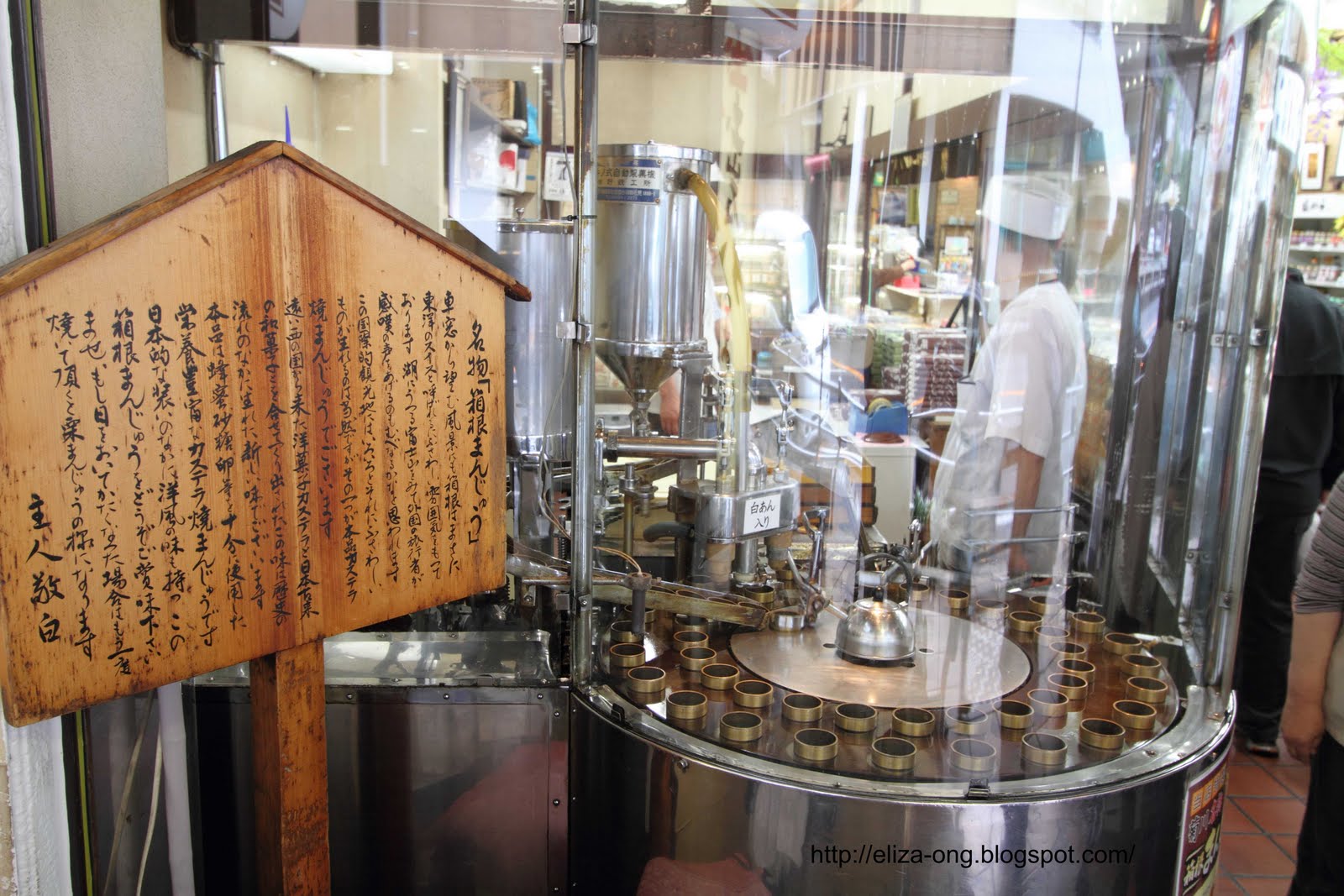
After that we hopped on the train for a slow ride down to Hakone Yumoto (Note: the bus is a faster way to travel, where available. From Gora, you must take the train.) At Hakone Yumoto town, we browsed around the 2 rows of shops, enjoying more food! It was particularly enjoyable seeing how the snacks were made.

Sunday, September 26, 2010

The Best of Hakone - Hakone Free Pass

The lovely "onsen" (hot springs) town of Hakone is a perfect getaway spot from the hustle and bustle of Tokyo city. The locals think so too, so be warned of the crowds during weekends and holidays. If you're a visitor, it would be best for you to plan a trip during a weekday if you prefer a more relaxing getaway without the maddening crowds.

Located around 100 kms West of Tokyo, the best way to experience Hakone is to get the Hakone Free Pass. The Hakone Free Pass provides a round trip return ticket from Shinjuku Station to Hakone as well as unlimited boarding of participating buses, ferries, trains, cable car and ropeway for 5,000 yen (2 days) or 5,500 yen (3 days). If you're not planning to return to Tokyo, consider getting the Hakone Free Pass from Odawara (3,900 yen) and just buying the 1 way ticket from Shinjuku Station to Odawara. I would also highly recommend paying an additional 870 yen one way to upgrade to the Odakyu Ltd. Express Romance Car for a more comfortable ride.

You can book the pass on-line and collect it at the Odakyu Sightseeing Centre in Shinjuku Station. They have a counter for international visitors. Together with your pass, you will get a circuit map which shows you the best way to get around Hakone using the various forms of transportation below:

Hakone Free Pass Transportation:
1. Odakyu Romance Car (pay to upgrade)
- From Shinjuku Station to Odawara/Hakone Yumoto

Hakone Tozan Bus
2. - The most efficient way to travel within Hakone


3. Hakone Tozan Train
A leisurely 40 minute ride from Hakone-Yumoto to Gora.


4. Hakone Sightseeing Cruise (Lake Ashi)
A splendid way to view the beauty of Lake Ashi aboard a pirate ship: Togendai - Motohakone-ko - Hakone-machi


5. Hakone Ropeway
Enjoy the panaromic view of the the mountain and hot springs: Sounzan to Togendai


6. Hakone Tozan Cable car
Take the short ride from Gora to Sounzan on this Swiss made cable car


The Hakone Free Pass is definitely worth getting. When we first arrived in Hakone, it was raining so we did the entire circuit without getting the full benefit of the views. Fortunately, we had blue skies the next morning, so we repeated the entire transport circuit, this time, with full enjoyment of the view. I'll share more about our experiences in the next post.

Tuesday, September 14, 2010

The Best Of Tokyo - Ramen

I love a bowl of steaming hot ramen noodles. Apart from the springy ramen noodles, crisp fried garlic slices and sliced roast pork served in creamy white miso soup, I love the Japanese hard-boiled egg, with its bright orange yolk. Here are 2 places which I found for good ramen in Tokyo. The first ramen shop which came recommended by the Lonely Planet is called Komen. It has a chain of 12 ramen shops in Tokyo. For non-Japanese speakers, look out for the 2 Japanese words encased in a large circle above the shop. I went to the Komen in Shinjuku (3-32-2, Shinjuku-ku, corner of Meiji-Dori and Koshu Kaido). This two storey ramen shop is big by ramen shop standards. They also have a branch in Harajuku.


Komen Ramen at Shinjuku


Big pots of stock for the ramen soup


Ramen with roast pork and white miso soup set - 990 yen

I stumbled onto the second ramen shop quite by accident. We were window shopping on the busy streets of Harajuku when this sign caught our attention. Walk down the stairs to a cosy little basement shop. Unfortunately, I don't know what the English name is but this shop is further down the street from the Lotteria at Takeshita Dori. The ramen is served in a stone bowl, which keeps it piping hot. In summer, the cold ramen is also quite popular. Personally, I found the ramen at this shop better than Komen.


Sigh...I wish I was back in Japan!

"We are noodle folk. Broth runs through our veins."
Mr. Ping, Kung Fu Panda (2008)