Showing posts with label Travel Tips. Show all posts

Monday, March 28, 2011

The Best of Takayama - Hida Folk Village (Hida no Sato)

It's been nearly a year since my trip to Japan. The earthquake, tsunami followed by the nuclear plant disaster has changed the landscape of Japan. I considered if I should continue to post about my trip and came to the conclusion that in the midst of the horror and tragedy, I want to remember the beauty of this nation.

One of the highlights of our visit to Takayama is the Hida Folk Village - a large open-air museum with a collection of antique houses from the region. We bought a bus and entrance pass from the Takayama bus station for 900 Yen.

Make sure you have on good walking shoes as the village is quite large, featuring over 30 farmhouses and traditional houses. Slip-on shoes would be preferred because you have to take your shoes off before you enter each traditional house.

Before I talk about the traditional houses, I have to talk about the view. We were blessed with a beautiful weather that day. This is what we saw...

...a breathtaking view of the peaks of the Japan Alps. This more than made up for not being able to see Mount Fuji when we were in Tokyo!

The village itself was no slouch either. The houses surround a lake and has rolling hills as backdrop.


The Japanese have such a keen appreciation for their culture and have taken great steps to preserve it. A lot of these houses were dismantled from their original sites and rebuilt in the village. I had originally wanted to visit Shirakawa-go, a UNESCO world heritage site to see the famed gassho-zukuri, the thatched A-frame style farmhouses. However, due to lack of time, we had to scratch that off our list. I was very happy to have gotten the opportunity to see an original gassho-zukuri at the Hida Folk Village.

The gassho-zukuri has steep thatched roof, designed to withstand the heavy snowfall in the region. Apparently, the name means "constructed like hands in prayer", as the roofs resemble the hands of Buddhist monks pressed together in prayer. The steep roof provides a large attic space to culivate silkworms.


Each house will display a sign to tell visitors a little bit about the history and time period of the house.


In some of the houses, you will get to see traditional crafts taking place, like weaving.


Most of the houses will have a traditional fireplace near the front of the home...


Some larger than others...


The Taguchi's house (village headman) is beautifully furnished with multiple rooms.


Others are much simpler...and used to display artefacts, such as this sledge.

The Hida Folk Village gets a thumbs up for showcasing Japanese culture and history, in a beautiful surrounding.

Saturday, December 18, 2010

The Best of Takayama, Japan

As we made our way south from Tokyo/Hakone to Kyoto, we took a detour cum side trip to the lovely town of Takayama, in the mountainous Hida district (west of Honshu Island). The journey on the Shinkansen involves a change of trains at Nagoya. The train journey from Hakone inclusive of transfers takes about 4.5 hours, but the scenery in the Hida region is spectacular. We also discovered later that the food rivals the scenery!

One of the many beautiful gorges in the Hida district


In spring, the cherry blossoms bloom by the riverside

Upon arrival in Takayama, we made our way on foot to our hotel, The Rickshaw Inn. As mentioned in an earlier post, it makes sense in Japan to use the luggage forwarding service. The Rickshaw Inn is centrally located in town. This small narrow inn is very popular among travellers as it is clean,reasonably priced and offers a little kitchen and laundry facility.


Our Japanese room - mattress on tatami mat.

Taller individuals (6 footers and above) should be careful when exiting the bedrooms as the door is quite short. They post a notice to be careful on the outside door but not on the inside. The bedroom is spacious but the bathrooms are rather narrow, typical of Japanese hotels.

We headed out to dinner to Origin, a Japanese pub (izakaya) located close to the train station. You won't find an English signage in the front, so look out for the bamboo poles.


As you enter the pub, you will come across a bar counter. Further inside, there are more rooms for dining. Origin has English menus but the staff don't speak much English.


Before we came to Japan, we had only heard of the famous Kobe Wagyu beef. When we arrived at the Hida district, we discovered a well-kept Japanese secret - the Hida beef - titled "The best beef in Japan" at the Eighth All Japan Beef Convention". Like the Kobe beef, the breed is also the Wagyu, but raised at the Hida district. Apparently, the success of the Hida beef is thanks to one bull "yasufukugo". According to some, since the yasufukugo was born, the Hida beef has become more marbled and tasty. I have to say that the Hida beef is the best I've tasted! Our first experience with the Hida beef at this local izakaya was good, but the best was yet to come.

Hida beef on Hoba Miso (DIY grill beef with Miso sauce on magnolia leaf)


One of the very nicest things about life is the way we must regularly stop whatever it is we are doing and devote our attention to eating.

~Luciano Pavarotti and William Wright, Pavarotti, My Own Story

Thursday, November 4, 2010

The Fujiya Hotel in Hakone

Accomodation in Hakone is expensive. Due to its proximity to Tokyo and its hot spring attraction, prices of decent accomodation can be quite high. In the end, we settled for the Fujiya Hotel located at Miyanoshita, Hakone-Machi. Because we had done our research beforehand, we already expected the bedrooms to be tired-looking. However we really only needed a place to sleep and at@USD100+taxes, their special anniversary plan for foreigners was worth it. The promotional hotel rate has since gone up to USD132+. The other aspects of the Fujiya Hotel - its architecture, gardens and history more than made up for its room decor.

Built in 1868, this aged, but graceful hotel has hosted many famous people ranging from rock stars (John Lennon) to royalty, actors to politicians. The Fujiya Hotel's architecture is impressive. We could not help but admire the intricate carvings and splendid details as we wandered around the hotel grounds.


They even have an indoor English chapel for weddings!


The Fujiya Hotel gardens are beautiful. As we were there in spring, we took a morning walk around the gardens which was in full bloom.


There was a quaint little hut with a water wheel - a favourite picture-taking spot among the guests.


Sit by the koi pond and enjoy the serene surroundings as you watch the golden fishes move gracefully underwater and listen to the gentle splash of the miniature waterfall
.

Be sure to pay a visit to the Fujiya Hotel Museum. Read about the history of the museum, its founders and guests. Wander around and admire the ancient knick knacks - like this picture of the "International Mustache Club".


If you're a Beatles fan, you will love this picture of John Lennon & Yoko Ono taken at the hotel.


The hotel has also kept its guests books from its early years.

The Fujiya Hotel is truly a grande dame among hotels!

Tuesday, October 19, 2010

Highlights of Hakone Free Pass Route

Hakone Free Pass Loop:
Hakone Machi (Lake Ashi cruise)- Togendai - Sounzan(Ropeway) - Gora (Cable car) - Hakone Yumoto (Train) (can also be done in reverse)

On our first day in Hakone, we started our tour with a bus ride from our hotel, the Fujiya to Moto Hakone. The weather was not in our favour, with intermittent rain and wind. But armed with borrowed hotel umbrellas, we plodded on. Our first stop was the Old Cedar Highway. It was awesome walking on the footpath surrounded by 400 year old cedar trees. The tall sturdy trees provided some respite from the rain and it was lovely to enjoy the serene surroundings.


From the Cedar Highway, we made our way on foot to Hakone Machi at Lake Ashi to board the pirate cruise boat to the other side of the Lake. At this stage, it was pouring cats and dogs. We really couldn't see much and as luck would have it, a bus-load of tourists came on board the ship, turning the pirate boat into a real pirate boat of the past - loud and noisy!


We went through the rest of journey on the ropeway, cablecar and train, just going through the motion and not really able to enjoy the sights, because it was just too dark, wet and cold. Fortunately for us, the weather turned and we had beautiful blue skies and bright sunshine the next day. We decided to repeat the Hakone Loop, and we were glad we did. What a difference from the day before! Instead of looking out from blurry windows filled with raindrops, we could actually enjoy the beautiful scenery of the lake and volcano mountain.


I thoroughly enjoyed the ropeway as it gave a bird's eye view of the volcano craters at Owakudani. The hot springs water from the volcano are channeled by pipelines to the various resorts in Hakone.


Be prepared to hold your nose because the sulphur fumes smells like rotten eggs!


Whist we're on the subject of eggs, every visitor must try the "black egg" at Owakudani. These eggs are 3/4 boiled, and are cooked in the volcano hot springs. Apart from the black shell, they taste just like normal eggs.


Still a couple of volcano-boiled eggs didn't quite satisfy the hunger pangs after we completed the loop at Gora, so we headed to the Gyoza Centre, a cosy little cafe which is about 1 km from the train station for a meal of dumplings.


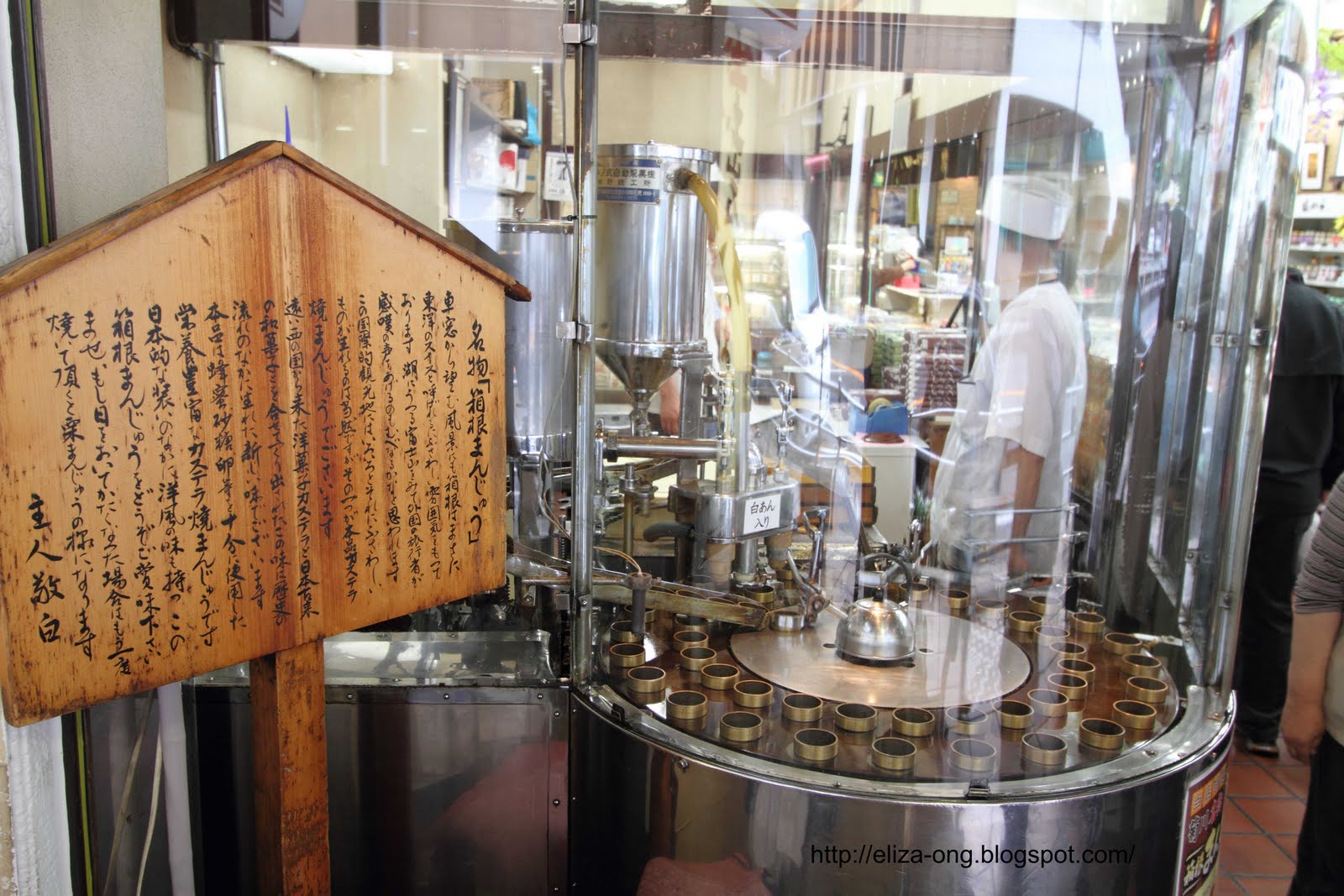
After that we hopped on the train for a slow ride down to Hakone Yumoto (Note: the bus is a faster way to travel, where available. From Gora, you must take the train.) At Hakone Yumoto town, we browsed around the 2 rows of shops, enjoying more food! It was particularly enjoyable seeing how the snacks were made.

Sunday, September 26, 2010

The Best of Hakone - Hakone Free Pass

The lovely "onsen" (hot springs) town of Hakone is a perfect getaway spot from the hustle and bustle of Tokyo city. The locals think so too, so be warned of the crowds during weekends and holidays. If you're a visitor, it would be best for you to plan a trip during a weekday if you prefer a more relaxing getaway without the maddening crowds.

Located around 100 kms West of Tokyo, the best way to experience Hakone is to get the Hakone Free Pass. The Hakone Free Pass provides a round trip return ticket from Shinjuku Station to Hakone as well as unlimited boarding of participating buses, ferries, trains, cable car and ropeway for 5,000 yen (2 days) or 5,500 yen (3 days). If you're not planning to return to Tokyo, consider getting the Hakone Free Pass from Odawara (3,900 yen) and just buying the 1 way ticket from Shinjuku Station to Odawara. I would also highly recommend paying an additional 870 yen one way to upgrade to the Odakyu Ltd. Express Romance Car for a more comfortable ride.

You can book the pass on-line and collect it at the Odakyu Sightseeing Centre in Shinjuku Station. They have a counter for international visitors. Together with your pass, you will get a circuit map which shows you the best way to get around Hakone using the various forms of transportation below:

Hakone Free Pass Transportation:
1. Odakyu Romance Car (pay to upgrade)
- From Shinjuku Station to Odawara/Hakone Yumoto

Hakone Tozan Bus
2. - The most efficient way to travel within Hakone


3. Hakone Tozan Train
A leisurely 40 minute ride from Hakone-Yumoto to Gora.


4. Hakone Sightseeing Cruise (Lake Ashi)
A splendid way to view the beauty of Lake Ashi aboard a pirate ship: Togendai - Motohakone-ko - Hakone-machi


5. Hakone Ropeway
Enjoy the panaromic view of the the mountain and hot springs: Sounzan to Togendai


6. Hakone Tozan Cable car
Take the short ride from Gora to Sounzan on this Swiss made cable car


The Hakone Free Pass is definitely worth getting. When we first arrived in Hakone, it was raining so we did the entire circuit without getting the full benefit of the views. Fortunately, we had blue skies the next morning, so we repeated the entire transport circuit, this time, with full enjoyment of the view. I'll share more about our experiences in the next post.

Friday, September 10, 2010

The Best of Tokyo - Cirque De Soleil's ZED

A friend recommended us to watch Cirque De Soleil in Tokyo, a recommendation that we were glad to have followed. Tokyo's Cirque de Soleil features the performance - ZED, a program that is shown only in Japan. Located at the Tokyo Disney Resort (10 minutes walk from JR Maihama Station on the Keiyo Line or Musashino Line to the Theatre via IKSPIARI and the Disney Ambassador Hotel), the Cirque du Soleil Theatre Tokyo is a resident theatre for Cirque du Soleil, designed specially for ZED.


We opted for the non-peak show at 4 p.m which is cheaper by 1,000 Yen compared to the 1 p.m. peak show performance. For foreigners, if you want to book your tickets on-line, go to the HIS Travel website which caters to non-Japanese speaking clientele.

Since the Cirque du Soleil Theatre Tokyo is located next to the Ikspiari shopping mall, you could spend the whole day here, enjoying some live entertainment shopping and eating first before catching the Cirque de Soleil performance later in the afternoon.


On a hot summer day, pop by Folletti Gerutta for a cool gelato. It's worth your while to brave the queues.


Be sure to look out for the Mickey Mouse buses and trains which ferry hotel guests to Tokyo Disneyland.


As with the theatre, the story of ZED was specially developed for Japan. The main character is ZED, a blonde afro-hair-styled "living poem" in the imaginary world of Arcana. The performance opens with a pair of hilarious clowns, and progresses to various breathtaking acts comprising high wire, bungee, flying trapeze, juggling, lassos, etc, etc. While not a flawless performance, the show is highly entertaining with outstanding special effects and high energies levels. One can't help but be drawn to ZED's adventures.


All in all, catching the Cirque de Soleil performance makes for a nice day trip out of Tokyo city!